Cryptography for Cybersecurity (CS 463)
What this course was and why it mattered
Cryptography for Cybersecurity (CS 463) is where I moved from using encryption to understanding what happens underneath it. It mattered because so much of security, from password storage to VPNs to compliance controls, rests on math most people never look at.
The work
The course covered the algorithms that secure modern systems: elliptic curve cryptography (ECC), including point addition and ECDH key exchange; symmetric ciphers like AES and DES; RSA public-key encryption; and the modular arithmetic and number theory that make all of it work. Much of it was done by hand.
Selected evidence
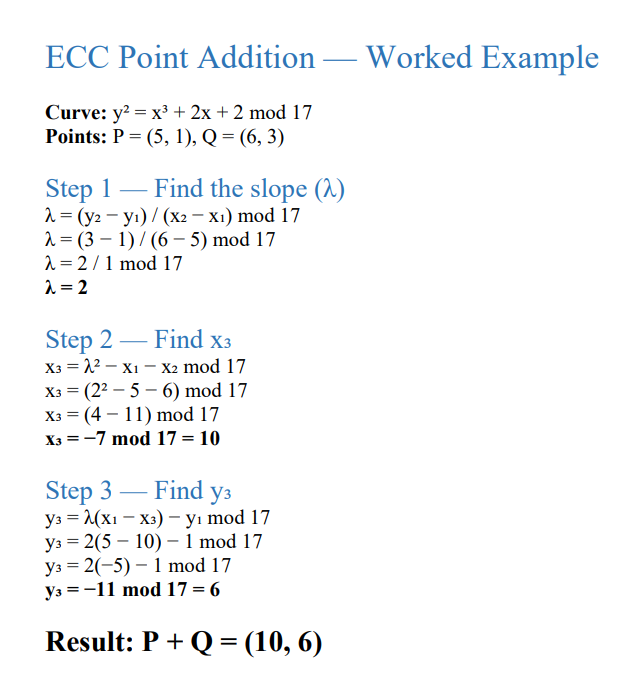
ECC point addition, worked by hand. I added two points, P = (5, 1) and Q = (6, 3), on the curve y² = x³ + 2x + 2 mod 17: first the slope, then x₃, then y₃, reducing every step mod 17 to get P + Q = (10, 6). I picked this one because point addition is the operation ECDH key exchange is built on. Once I had done it by hand, the “shared secret” in key exchange stopped being a black box.
Reflection
Working through ECC point addition and ECDH key exchange by hand changed how I think about the tools I already use. Hashcat’s cracking approaches only made real sense once I understood the key-space math and hashing behind them. Before this course I was running the tool without fully grasping why some hash types crack faster than others. Comparing AES and DES against RSA also cleared up something I’d been fuzzy on: why systems pair symmetric and asymmetric encryption instead of picking one.
This connects directly to the compliance side of my internship. CMMC’s data-protection requirements assume you understand this material. You can’t judge whether an organization’s encryption controls are adequate if you don’t understand what’s happening under the “encryption enabled” checkbox.